
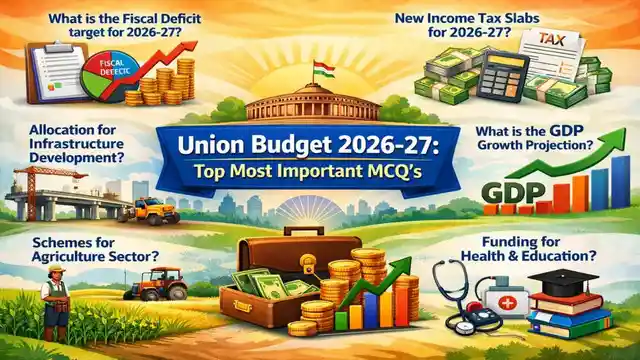
Union Budget 2026-27
Top Most Important MCQ?s
PART A: INDIA?S BUDGET 2026-27
Q1. The three pillars of the Kartavya Framework do NOT include which of the following?
A) Accelerate Sustainable Economic Growth
B) Strengthen Agricultural Subsidy Distribution
C) Fulfill Aspirations & Build Capacity
D) Inclusive Development (Sabka Sath, Sabka Vikas)
Answer: B
Q2. Which of the following best describes the ?Kartavya 1? pillar?
A) Direct wealth redistribution to marginalized communities
B) Enhance productivity and competitiveness while maintaining structural reforms momentum
C) Elimination of all foreign trade barriers
D) Mandatory government employment for all citizens
Answer: B
Q3. According to the budget, how many individuals have been lifted out of multidimensional poverty as of the document date?
A) 15 crore
B) 20 crore
C) 25 crore
D) 30 crore
Answer: C
Q4. The Reform Express initiative includes how many rollouts post-Independence Day 2025?
A) 200+
B) 250+
C) 350+
D) 400+
Answer: C
Q5. Which THREE areas are identified as Supporting Ecosystem Requirements for growth?
A) Agricultural subsidies, Price controls, Bureaucratic oversight
B) Continuous structural economic reforms, Robust financial sector, Cutting-edge technologies
C) Tariff barriers, Limited FDI, Government monopolies
D) None of the above
Answer: B
Q6. The Biopharma SHAKTI scheme has an outlay of ?10,000 crore over how many years?
A) 3 years
B) 5 years
C) 7 years
D) 10 years
Answer: B
Q7. How many new NIPER (National Institutes of Pharmaceutical Education & Research) institutions will be established under Biopharma SHAKTI?
A) 2
B) 3
C) 5
D) 7
Answer: B
Q8. The clinical trial network target under Biopharma SHAKTI is:
A) 500+ accredited sites
B) 750+ accredited sites
C) 1,000+ accredited sites
D) 1,500+ accredited sites
Answer: C
Q9. Which of the following is NOT a focus area of India Semiconductor Mission 2.0?
A) Manufacture semiconductor equipment domestically
B) Design full-stack Indian intellectual property solutions
C) Establish retail semiconductor outlets across India
D) Develop skilled workforce in semiconductor technology
Answer: C
Q10. The Electronics Components Manufacturing Scheme previous outlay was ?22,919 crore (launched April 2025). The proposed enhancement is:
A) ?30,000 crore
B) ?35,000 crore
C) ?40,000 crore
D) ?45,000 crore
Answer: C
Q11. What was the investment achievement ratio against target for Electronics Components Manufacturing Scheme?
A) 1.5x
B) 2x
C) 2.5x
D) 3x
Answer: B
Q12. The Rare Earth Permanent Magnets Scheme was launched in:
A) August 2025
B) September 2025
C) November 2025
D) December 2025
Answer: C
Q13. Which of the following states is NOT mentioned as a mineral-rich state in the Rare Earth Corridors initiative?
A) Odisha
B) Kerala
C) Maharashtra
D) Andhra Pradesh
Answer: C
Q14. The Container Manufacturing Scheme has an outlay of ?10,000 crore over:
A) 3 years
B) 5 years
C) 7 years
D) 10 years
Answer: B
Q15. How many sub-components does the Textile Sector Integrated Programme have?
A) 3
B) 4
C) 5
D) 6
Answer: C
Q16. The National Fibre Scheme aims to achieve self-reliance in which of the following?
A) Only synthetic fibres
B) Only natural fibres (silk, wool, jute)
C) Both natural and man-made fibres including new-age fibres
D) Only cotton and polyester
Answer: C
Q17. Which textile scheme specifically focuses on skilling modernization with industry-academic collaboration?
A) Textile Expansion & Employment Scheme
B) Samarth 2.0
C) Tex-Eco Initiative
D) National Handloom & Handicraft Programme
Answer: B
Q18. The Hi-Tech Tool Rooms under Capital Goods Capability Building will be established at:
A) 1 location
B) 2 locations
C) 3 locations
D) 5 locations
Answer: B
Q19. Which construction-related equipment is specifically mentioned in the Construction & Infrastructure Equipment Scheme?
A) Concrete mixers only
B) Lifts, fire-fighting equipment, tunnel-boring equipment, high-altitude road machinery
C) Only excavators
D) Only cranes
Answer: B
Q20. How many legacy industrial clusters are targeted for rejuvenation under the cluster revitalization scheme?
A) 100
B) 150
C) 200
D) 250
Answer: C
Q21. The SME Growth Fund has an outlay of:
A) ?5,000 crore
B) ?8,000 crore
C) ?10,000 crore
D) ?15,000 crore
Answer: C
Q22. The Self-Reliant India Fund Top-Up allocation is:
A) ?1,000 crore
B) ?1,500 crore
C) ?2,000 crore
D) ?3,000 crore
Answer: C
Q23. The current TReDS (Trade Receivables e-Discounting System) availability to MSMEs is:
A) ?5 lakh crore
B) ?7 lakh crore
C) ?9 lakh crore
D) ?10 lakh crore
Answer: B
Q24. Which of the following is NOT listed as a measure to leverage TReDS potential?
A) Mandatory CPSE Integration
B) Credit Guarantee Mechanism
C) Direct government grants to MSMEs
D) GeM-TReDS Linkage
Answer: C
Q25. The GeM-TReDS linkage aims to achieve which of the following?
A) Better financing visibility and cheaper, quicker credit only
B) Eliminate traditional banking completely
C) Reduce government procurement transparency
D) Increase MSME interest rates
Answer: A
Q26. The TReDS receivables asset-backed securities initiative falls under which category of support?
A) Equity Support
B) Liquidity Support
C) Professional Support
D) Technology Support
Answer: B
Q27. The Corporate Mitras Programme facilitates short-term, modular courses through:
A) Private corporations only
B) Government training institutes
C) Professional Institutions (ICAI, ICSI, ICMAI)
D) Foreign universities
Answer: C
Q28. The Corporate Mitras Programme specifically targets:
A) Only metropolitan areas
B) Tier-I cities exclusively
C) Tier-II and Tier-III towns
D) Rural areas only
Answer: C
Q29. What benefit does the Corporate Mitras Programme provide to MSMEs?
A) Direct equity investment
B) Affordable compliance support through accredited para-professional cadre
C) Government subsidies
D) Forced technology adoption
Answer: B
Q30. The public capital expenditure in FY2014-15 was ?2 lakh crore. What is the proposed allocation for FY2026-27?
A) ?10 lakh crore
B) ?11.2 lakh crore
C) ?12.2 lakh crore
D) ?13.2 lakh crore
Answer: C
Q31. The Infrastructure Risk Guarantee Fund provides:
A) Full credit guarantees to all borrowers
B) Prudently calibrated partial credit guarantees to lenders
C) Direct grants to infrastructure developers
D) Mandatory equity stakes
Answer: B
Q32. The new Dedicated Freight Corridor connects:
A) Delhi to Mumbai
B) Dankuni (East) to Surat (West)
C) Chennai to Bengaluru
D) Kolkata to Hyderabad
Answer: B
Q33. How many new National Waterways are planned to be operationalized over 5 years?
A) 10
B) 15
C) 20
D) 25
Answer: C
Q34. National Waterway-5 in Odisha connects which industrial areas to ports?
A) Raipur-Angul to Visakhapatnam
B) Talcher-Angul to Paradeep/Dhamra ports
C) Jharia to Haldia
D) Singareni to Kakinada
Answer: B
Q35. The Coastal Cargo Promotion Scheme targets increasing the share of inland waterways and coastal shipping from 6% to:
A) 8% by 2047
B) 10% by 2047
C) 12% by 2047
D) 15% by 2047
Answer: C
Q36. Ship Repair Ecosystems will be established at:
A) Mumbai and Kochi only
B) Chennai and Visakhapatnam
C) Varanasi and Patna
D) Surat and Mandvi
Answer: C
Q37. How many High-Speed Rail Corridors are proposed?
A) 5
B) 6
C) 7
D) 8
Answer: C
Q38. Which of the following is NOT among the proposed High-Speed Rail Corridors?
A) Mumbai-Pune
B) Pune-Hyderabad
C) Delhi-Kolkata
D) Chennai-Bengaluru
Answer: C
Q39. The seaplane initiatives primarily aim to:
A) Replace commercial aviation entirely
B) Provide remote connectivity and tourism promotion
C) Eliminate helicopter services
D) Create luxury travel only
Answer: B
Q40. The CCUS (Carbon Capture, Utilization & Storage) Roadmap was launched in:
A) October 2025
B) November 2025
C) December 2025
D) January 2026
Answer: C
Q41. The CCUS initiative outlay is ?20,000 crore over:
A) 3 years
B) 5 years
C) 7 years
D) 10 years
Answer: B
Q42. Which sector is NOT mentioned as a focus sector for CCUS technologies?
A) Power
B) Steel
C) Retail
D) Cement
Answer: C
Q43. City Economic Regions (CERs) focus primarily on:
A) Rural agricultural development
B) Tier-II, Tier-III cities, and temple towns
C) Metropolitan expansion only
D) Industrial manufacturing clusters
Answer: B
Q44. The allocation per City Economic Region over 5 years is:
A) ?3,000 crore
B) ?4,000 crore
C) ?5,000 crore
D) ?6,000 crore
Answer: C
Q45. The financing model for CERs is:
A) Direct grant disbursement
B) Challenge mode with reform-cum-results-based mechanism
C) Zero-interest loans only
D) Private sector-only funding
Answer: B
Q46. Which government initiative aims to drive technology adoption for farmers, women in STEM, and persons with disabilities?
A) Manufacturing Excellence Mission
B) Digital India Programme
C) AI Mission, National Quantum Mission, Anusandhan National Research Fund, and R&D Innovation Fund
D) Make in India
Answer: C
Q47. Current banking sector coverage of villages in India is:
A) 85%
B) 90%
C) 95%
D) 98%+
Answer: D
Q48. A High-Level Committee on Banking for Viksit Bharat has been constituted with mandate to review banking while safeguarding:
A) Only profitability
B) Only financial stability
C) Financial stability, inclusion objectives, and consumer protection
D) Regulatory compliance only
Answer: C
Q49. Which of the following is a proposed NBFC restructuring initiative?
A) Privatize all public sector NBFCs
B) Restructure Power Finance Corporation and Rural Electrification Corporation
C) Eliminate NBFC sector
D) Merge all NBFCs with banks
Answer: B
Q50. The Foreign Exchange Management (Non-debt Instruments) Rules initiative aims to:
A) Restrict foreign investment
B) Create contemporary, user-friendly rules aligned with India?s evolving priorities
C) Eliminate foreign direct investment
D) Increase bureaucratic controls
Answer: B
Q51. The corporate bond market development includes introduction of market making for:
A) Government securities only
B) Corporate bond indices
C) Only blue-chip company bonds
D) Small cap bonds exclusively
Answer: B
Q52. The Municipal Bonds Incentive Scheme provides an incentive of ?100 crore for single bond issuance greater than:
A) ?500 crore
B) ?750 crore
C) ?1,000 crore
D) ?1,500 crore
Answer: C
Q53. The AMRUT scheme continues supporting bond issuances up to:
A) ?100 crore
B) ?150 crore
C) ?200 crore
D) ?250 crore
Answer: C
Q54. Portfolio Investment Scheme (PIS) liberalization includes permitting PROI to invest in:
A) Government securities only
B) Listed company equity
C) Real estate only
D) Unlisted companies
Answer: B
Q55. The individual PROI limit has been increased from 5% to:
A) 7%
B) 8%
C) 10%
D) 12%
Answer: C
Q56. The overall PROI limit has been raised from 10% to:
A) 15%
B) 18%
C) 24%
D) 28%
Answer: C
Q57. The High-Powered ?Education to Employment and Enterprise? Standing Committee targets achieving what percentage of global services share by 2047?
A) 5%
B) 8%
C) 10%
D) 15%
Answer: C
Q58. How many Allied Health Professionals (AHPs) are targeted to be added over 5 years?
A) 50,000
B) 75,000
C) 100,000
D) 150,000
Answer: C
Q59. Year 1 target for training caregivers under AHP Care Ecosystem Development is:
A) 50,000
B) 75,000
C) 1 lakh (100,000)
D) 1.5 lakh (150,000)
Answer: D
Q60. How many Regional Medical Value Tourism Hubs are planned to be supported?
A) 3
B) 4
C) 5
D) 7
Answer: C
Q61. Medical Value Tourism Hubs will integrate which system?s centres?
A) Only Allopathic
B) Only Homeopathic
C) AYUSH Centres
D) Only Unani
Answer: C
Q62. The WHO Global Traditional Medicine Centre that will be upgraded is located in:
A) Delhi
B) Mumbai
C) Jamnagar
D) Varanasi
Answer: C
Q63. How many new All India Institutes of Ayurveda will be established?
A) 1
B) 2
C) 3
D) 5
Answer: C
Q64. The Orange Economy sector (AVGC) requires how many professionals by 2030?
A) 1 million
B) 1.5 million
C) 2 million
D) 2.5 million
Answer: C
Q65. AVGC Content Creator Labs will be established in how many secondary schools?
A) 5,000
B) 10,000
C) 15,000
D) 20,000
Answer: C
Q66. AVGC Content Creator Labs will be established in how many colleges?
A) 200
B) 300
C) 400
D) 500
Answer: D
Q67. The new National Institute of Design will focus on:
A) Western India only
B) Southern India
C) Eastern India (to address geographic concentration)
D) Northern India
Answer: C
Q68. How many University Townships are planned via challenge route?
A) 2
B) 3
C) 4
D) 5
Answer: D
Q69. University Townships will be located near:
A) Agricultural areas only
B) Major industrial and logistic corridors
C) Coastal regions only
D) Hilly regions
Answer: B
Q70. The girls? hostel in higher STEM education initiative targets establishing:
A) 1 hostel per state
B) 1 hostel per district
C) 1 hostel per region
D) 1 hostel per university
Answer: B
Q71. How many telescope infrastructure projects are included in Astrophysics & Astronomy Development?
A) 2
B) 3
C) 4
D) 5
Answer: C
Q72. The National Institute of Hospitality upgrades which existing institution?
A) IIHM
B) National Council for Hotel Management & Catering Technology
C) ITC Institute
D) NRAI Academy
Answer: B
Q73. The Tourism Guide Upskilling Pilot scales across how many iconic tourist sites?
A) 10
B) 15
C) 20
D) 25
Answer: C
Q74. The Tourism Guide training course duration under the pilot is:
A) 8 weeks
B) 10 weeks
C) 12 weeks
D) 16 weeks
Answer: C
Q75. Which institute partners with the Tourism Guide Upskilling Programme?
A) NITI Aayog
B) Indian Institute of Management
C) NASSCOM
D) Federation of Indian Chambers of Commerce
Answer: B
Q76. How many archaeological sites are planned to be transformed into vibrant, experiential destinations?
A) 10
B) 12
C) 15
D) 20
Answer: C
Q77. Which of the following archaeological sites is mentioned for transformation?
A) Mohenjo-daro
B) Lothal
C) Both A and B
D) Neither A nor B
Answer: B
Q78. The Buddhist Circuit Development covers which region?
A) South India only
B) North-East region (Arunachal Pradesh, Sikkim, Assam, Manipur, Mizoram, Tripura)
C) Central India
D) Western India
Answer: B
Q79. The International Big Cat Alliance had its first-ever Global Big Cat Summit in:
A) 2025
B) 2026
C) 2027
D) 2028
Answer: B
Q80. How many range countries participated in the Global Big Cat Summit?
A) 50
B) 75
C) 95
D) 120
Answer: C
Q81. Sustainable Trekking Infrastructure includes trails in the Himalayas and:
A) Sahyadri Ranges
B) Araku Valley (Eastern Ghats) and Podhigai Malai (Western Ghats)
C) Nilgiris
D) Cardamom Hills
Answer: B
Q82. Turtle Trails are developed in coastal areas including:
A) Only Kerala
B) Only Odisha
C) Odisha, Karnataka, and Kerala
D) Maharashtra and Goa
Answer: C
Q83. The Khelo India Mission is based on a:
A) 5-year vision
B) 8-year vision
C) 10-year vision
D) 15-year vision
Answer: C
Q84. The Khelo India Mission includes how many component areas?
A) 3
B) 4
C) 5
D) 6
Answer: C
Q85. The talent development pathway in Khelo India includes:
A) Only foundational training
B) Foundational, intermediate, and elite-level training
C) Only elite-level training
D) Only intermediate training
Answer: B
Q86. Sports Science & Technology Integration in Khelo India emphasizes:
A) Only traditional methods
B) Modern technology adoption and data-driven athlete development
C) Elimination of coaching
D) Individual-only training
Answer: B
Q87. Livestock contributes what percentage to farm income?
A) 10%
B) 14%
C) 16%
D) 20%
Answer: C
Q88. How many reservoirs and Amrit Sarovars are planned to be developed?
A) 200
B) 300
C) 400
D) 500
Answer: D
Q89. The Coconut Promotion Scheme focuses on which aspect?
A) Coconut export subsidies
B) Old/non-productive tree replacement with new saplings/varieties
C) Import substitution
D) Price controls
Answer: B
Q90. How many people in India are dependent on coconut sector (including farmers)?
A) 10 million people (5 million farmers)
B) 15 million people (8 million farmers)
C) 20 million people (10 million farmers)
D) 30 million people (10 million farmers)
Answer: D
Q91. The target year for ?Indian Cashew? and ?Indian Cocoa? to become premium global brands is:
A) 2028
B) 2030
C) 2032
D) 2035
Answer: B
Q92. BHARAT-VISTAAR (Virtually Integrated System to Access Agricultural Resources) is a:
A) Physical storage system
B) Multilingual AI tool integrated with AgriStack and ICAR
C) Government procurement platform
D) Insurance scheme
Answer: B
Q93. The SHE-Marts initiative builds on which existing programme?
A) PM-KISAN
B) Pradhan Mantri Mudra Yojana
C) Lakhpati Didi Programme
D) Swachh Bharat
Answer: C
Q94. SHE-Marts are structured as:
A) Government-owned retail outlets
B) Private corporate franchises
C) Community-owned retail outlets integrated at cluster-level federation
D) E-commerce platforms
Answer: C
Q95. The Divyangjan Kaushal Yojana targets employment in:
A) Only IT sector
B) IT, AVGC, Hospitality, Food & Beverages
C) Only manufacturing
D) Only agriculture
Answer: B
Q96. ALIMCO stands for:
A) Artificial Learning for India Manufacturing Council
B) Artificial Limbs Manufacturing Corporation of India
C) Assistive Living & Manufacturing Co. India
D) Advanced Logistics & Manufacturing Council
Answer: B
Q97. Assistive Technology Marts allow customers to:
A) Only purchase assistive devices
B) See, try, and purchase assistive products
C) Only rent devices
D) View catalogs only
Answer: B
Q98. NIMHANS-2 will be established in:
A) South India
B) North India
C) Eastern India
D) North-Eastern India
Answer: B
Q99. The Emergency and Trauma Care Centre expansion targets:
A) 25% capacity increase
B) 35% capacity increase
C) 50% capacity increase
D) 75% capacity increase
Answer: C
Q100. The 16th Finance Commission submission date to the President was:
A) 15 November 2025
B) 17 November 2025
C) 20 November 2025
D) 25 November 2025
Answer: B
Q101. The Finance Commission?s vertical devolution share has been retained at:
A) 39%
B) 40%
C) 41%
D) 42%
Answer: C
Q102. Finance Commission Grants for FY2026-27 are:
A) ?1 lakh crore
B) ?1.2 lakh crore
C) ?1.4 lakh crore
D) ?1.6 lakh crore
Answer: C
Q103. The target for Debt-to-GDP ratio by 2030-31 is:
A) 45?1%
B) 50?1%
C) 55?1%
D) 60?1%
Answer: B
Q104. Debt-to-GDP ratio in Budget Estimate 2026-27 is:
A) 54.6% of GDP
B) 55.6% of GDP
C) 56.6% of GDP
D) 57.6% of GDP
Answer: B
Q105. FY2025-26 fiscal deficit (RE) was:
More in Education



Mar 24, 2024
Read Article
List of Former Governors of Himachal Pradesh


Mar 24, 2024
Read Article
Nobel Prize 2025 Important MCQs


Mar 24, 2024
Read Article
Coding Decoding in Hindi

Mar 24, 2024
Read Article
Direction and Distance Reasoning in Hindi

Mar 24, 2024
Read Article
National Highways in Himachal Pradesh


Mar 24, 2024
Read Article
Rabi and Kharif Crops


Mar 24, 2024
Read Article
Himachal Pradesh One Liner Questions

Mar 24, 2024
Read Article
Himachal Pradesh One Liner Questions



Mar 24, 2024
Read Article
Data Science MCQs
Mar 24, 2024
Read Article
Computer Vision MCQs
Mar 24, 2024
Read Article
Indian History : Vedic Civilization
Mar 24, 2024
Read Article
Indian History : Indus Valley Civilization
Mar 24, 2024
Read Article
World History : World War 1


Mar 24, 2024
Read Article
World History : World War 2
Mar 24, 2024
Read Article
Indian History : Ancient India History

Mar 24, 2024
Read Article
World History : Cold War
Mar 24, 2024
Read Article
Indian History : Medieval Indian History

Mar 24, 2024
Read Article
Indian History : Modern Indian History
Mar 24, 2024
Read Article
Indian History : Delhi Sultanate

Mar 24, 2024
Read Article
The Gupta Dynasty MCQs
Mar 24, 2024
Read Article